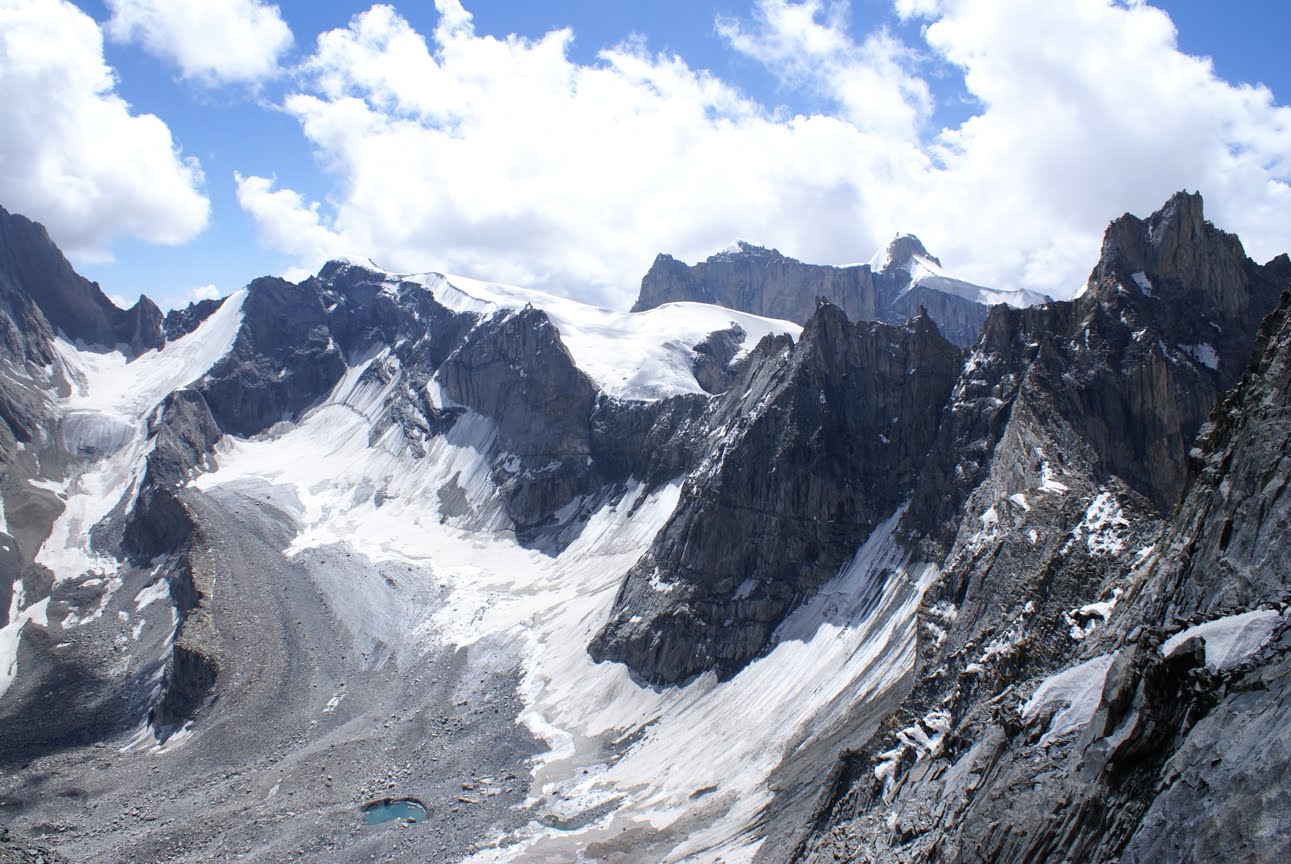
K2 It is the second-highest mountain on Earth, only after Mount Everest. It has a peak elevation of 8,611 m [28,251 feet]!!!
K2 has never been climbed in winter.


According to the Tibetan sources, mang yul (mi rigs man po'i yul) a land of many peoples is used in respect of the inhabitants of Western Himalayas (Himavanta). The ethnic description of the area is suggestive. The Indian Puranas mention that this snow-clad area is where the Naga, the Asura, the Yaksa, the Kinnara, the Gandharva were distinct from the Aryan (aryajana) inhabitants of Sindhu and Ganga river valleys and from the Dramila people belonging to the south of the Vindhya hills.
The Western Himalayas refer to Ladakh and its adjacent area like Kashmir (Kha che), Kandahar (Gandhara) and its eastern highland up to Lahul (Iha yul). Mang yul which indicates an extensive area of the west and the north-west Himalayas had been a seat of hetrogenous peoples with a cultural fusion. Through the culture-scope of the Western Himalayan inhabitants one may observe various spectra while the scenario is wide and varied.
The traditional geographical name of this area is praticya, the western region adjacent, to udicicya, the northern belt of Bharatavarsa. Obviously, the extent of the Western Himalayas included a wide uneven area of mountain gorges, valleys and ravines in which Kashmir, Gandhara, Kamboj and Madra janapadas belonged adjacent to Uttarakuru varsa.
A large number of Bod (Tibetan) people of Mongoloid origin preferred to spread in this area for several centuries. Their settlements cover a wide area of Balti, Ladakh, Spiti, Lahul and the Dokupa of northern belt. Here, a brief account about that movement of the peoples concerned may focus the genesis of their speeches.
For instance, Ladakh was an independent State comprising a large part of Western Tibet in olden days. A chronicle of Ladakh compiled in the 17th century called La dvags rgyal rabs, meaning the "Royal Chronicle of the kings of Ladakh", recorded that this boundary was traditional and well-known. A.H. Francke translates the portion of the text as follows:
"He (skyid lde nyima mgon) had to each of these three sons a separate kingdom, viz; to the eldest, Dpal gyimgon, Maryul of Mnah-ris, the inhabitants using black bows; Ru-thogs of the east and the Gold-mine of Hgog; nearer this way Lde mchog-dkar-po; at the frontier Ra-bar-dmar-po; Wam-le, to the top of the pass of the yi-mig rock..."Here Maryul means the low land in contrast to the high land of further north west sloping down. By the 10th century A.D. the boundary of Ladakh was upto Ruthog (Rudok) in the north and Lde mchog dkar po (Demchok) in the east. The yimig rock was adjacent to Imis pass and Wamle (i.e., Hanle). The present inhabitants of Spiti and Lahul were generally administered separately, though they belonged to the Mongoloid group.
According to the inscriptional evidence (7th century A.D.) Spiti was ruled by a Sena Dynasty. (See Corpus Inscriptionum Indicarum Vol. III. p. 288-9 by fleet). Raja Samudra Sena granted a copper plate tamra-sasana for founding Parasurama temple at Nirmand. The Vamsavati of Kulu also refer to Raja Rajendra Sena became victorious in Kulu but Raja Chet Sena lost.
The Tibetan records mention the annexation of the Spiti valley and Pare valley by Ladakh by the 10th century A.D. An order from the Head Lama of Hemis Gonpa of Ladakh is cited below:
"Order issued by Head Lama Dechon Namgial, ruler of Hemi Gunpa of Ladakh in concurrence with 200 Lamas delegating administrative powers to Nono Sonam Lotan of Churup: Following are the boundary limits of villages of Karak, Bargaiok, Sumkhel, Goondi, Churup, Tummur and Geu which fall within the jurisdiction of Hemi Gumpa and include forests, pasture lands, woods and water for irrigation".Subsequently Spiti came under the occupation of Skyid lde nyi ma mgon in the 10th century A.D. The Ladakh chronicles state that the second son "he made ruler over Guge with Pu hrans (Purang) Rtse (Tse) etc. Lde gzuz mgon, the youngest was made a ruler over Zans dkar sgo gsum".
Zans dkar sgo gsum, the 'three doors' of Zanskar, was a reference presumably to the three valleys that join at the central part of Zanskar. Spi lcogs has been identified as Lahul (lha yul) which lies between Zanskar and Spiti referring to one of the three valley-doors (sgo gsum) of Zanskar.
The inhabitation consisted of Zhang Zhung pa who practised Pon (Bon) prior to the advent of Kyidenyimagon. Zang Zung pa settled in Stod (pa) (of upper region), smad (pa) (lower), and Bar (pa) of middle localities including Yo yul, Guge and Thoding (mtho lding). Among the inhabitants of those areas, Reng pa (in Naka), Ha srang, Tocho etc. the villagers preserve their clanwise distinctions though mutual exchange of commodities has prevailed since olden days.
Genera of Speeches in Western Himalayas
In the Western Himalayas there had been multiple of speeches spoken by different groups since the olden days. The Indus valley had been the seat of many peoples prior to the advent of the Aryans in that area.
As far as the literary evidences go, Panini (400 A.D.) endeavoured to systematise an acceptable speech after refinement out of various speeches which had then been prevalent in that region. In the history of the human language, it was probably the earliest endeavour of scientific systematisation in the human speech. He mentioned his predecessors like Sakatayana, Varsayania Yaska, Mahesa and others. He took a bold step to declare his endeavour as samskrta bhasa. Samskrta literally suggests that which is refined or put together for purification. He distinguished samskrta from prakrta or common people speech or from the speeches of asura, pisaca and mleccha. Here, asura, pisaca and mleccha refer to those groups of people who failed to pronounce Samskrta bhasa.
Who are the Asuras? The Asuras are said to have been incompetent in articulation of vowels and consonants accurately. The Satapatha Brahmana takes care of the proper articulation of samskrta (Vedic) consonants and vowels. For instance, they failed to articulate the araya (h), correctly; 'helava helava' they-uttered (te 'asura attavacasa he 'alava he' 'alava 3.2.1.23). The Madhyandina-branch of the Satapathi Brahmins were occasionally indifferent to correct articulation; so that they got corrupt recitation as the mlecchas did.
Mleccha were those who could not pronounce Samskrta (vak) appropriately as prescribed in the Svarabidhana of the grammatical treatises. Mostly the mlecchas were the Kirata, the Savara, the Pulinda (Amarakosa, Sudravarga).
Linguistically, Samskrta bhasa is regarded as an offshoot of the Indo-European Speech Family. The Iranian speeches are considered as the sister Family of the Indo-Aryan Speech. It suggests that the Iranian language has got affinity with Vedic Sanskrit. Among the scholars who hold that the Aryans had their early home in the region of Bulk (Bactria) and Sogdiana in vicinity of Bokhara on the bank of Oxus (vaksu) river acknowledge that two courses of spoken language developed in India and Iran though closely to one another.
(i) The Indian group refers to the Vedic speech together with ancient Prakrits, which were endeavoured by Panini (400 A.D.) for refinement. Those speeches are broadly named the Old Indo-Aryan (OIA) languages with their subsequent development in the Middle Indo-Aryan (MIA) i.e. Pali, Jaina Prakrit (Ardha Magadhi) and important branches of Prakrita like Maharastri, Sauraseni, Magadhi. Again those are changed into the speeches of Apabhramsa, and, thereafter 'bhasa' like Hindi, Assamese, Oriya, Bengali, Gujrati, Marathi, etc.Balti, Bodhi (bhoti), Spiti and Lahuh speeches
(ii) The Iranian Zend (or Zand) referes to its specimens available in the Avesta texts. Old Persian or Achemenian, Pahlavi, Modern Persian, Pustu and Armenian belong to this group.
(iii) The Semetic languages derived from the Assyrian, Hebrew, Armanic (Aramaen) refer to Arabic, Himgaritic which are said to have entered the Western Himalayas after the advent of Islam.
(iv) The inhabitants of Balti which is bounded on the north by the Muztagh range and Nagar, on the east by Ladakh, on the south by Wardwan and Zanskar and on the west by Gilgit and Astor speak a language distinct from the Western Tibetan Dialect or Bodi, Budhlor Bhot of Ladakh. Grierson in his Linguistic Survey of India (III.3) mentions the special characteristics of Balti. Sprigg has recently studied the peculiarities of the Balti speech in general.
(v) The Brukpa people who are said to have migrated from Dardistan speak a distinct speech other than Balti and Ladakhi. In this respect, Siddheswar Varma in his study on Burushaski Language (1920) has focussed the linguistic peculiarities verily. At the same time the traditional account of the Bon-po priests, who had once migrated frorn Tazik (Stag gzig, broadly identified with Iran or old Persia in the Tibetan Literature), refer to their previous settlement in Brudza, (also written brug dza/brug toha/bru sa) in the Western Himalayas. The Bon po priests had there a separate speech named Zhang Zhung (also pron. hsang hsung/Shang Shung) which does not hold resemblance to Bodi/Bhoti of Ladakh offshooted from the Western Tibetan dialect, i.e. toi ka (stod skad).
The Western Himalayas are inhabited by the Mon po, the Tchang pa (byan : The northern people), the Dards and the Mongoloids of Ladakh, Spiti and Lahul. The Brukpas do not claim themselves Mongoloids. Except the Muslims including those of Purig and Gilgit, the population professes Buddhism. In Ladakh and Lahul some Christian families are observed. In respect of the Buddhists, the written language is chos skad the uniform language used in the Buddhist scriptures. No divergence is observed there.
The Mons, the Tchang and the Dards who reside in the north west of Kashmir valley are said to have migrated since the Kusana period of the early Christian era. Mihirokula of the Hunas (6th century A.D.) could extend his control upto Ladakh. The Tibetan sources, claim that Srong btsan sgam po (650 A.D.) conquered the territory upto Gilgit and the Pamirs. The Rajatarangini refers to the Tibetan control in that area as Lalitaditya (699-736 A.D.) is reported to have driven out the Bhauttas (Tibetans) out of his kingdom.
The western Tibetan dialect of Tibetan i.e. Nyargi ka (mna' ris skad) is said to have been induced in this area by the different hetrogenous groups of Bhotias since the 7th century A.D., though the Ladwags kyi rgyal rab is silent. The Baltispeaking persons reside in Ladakh, Kargil and Baltistan. The Balti speakers invented their separate script after embracing Islam in the early 15th century A.D. Purik (Pu rig) which belonged to Ladakh earlier was handed over to the Raja of Bait] after the Dogra war against Ladakh (1846 A.D.). The Bhauttas inhabit the area from Zojila to Mulbeck to Dras.
The Western Tibetan Dialects (Toi-ka)
(i) Nyarika (mn a' ris skad): The people residing in Ruthak (Rudok), Gartok, Yumbamtsang, Hundesh, Bhongtha, Kailas Mansarovar and Surnge usually speak a specific dialect. The main peculiarity of this dialect is to maintain the suffix letters or jenjuk (res 'jug) letters of a word and to retain the sound Sange Lango and rango, while they remain in the second part of the compound words.To kat or Stod skad (the broad nomenclature of the Tibetan dialects of the Western Tibet including Nyari-ka and Tcang-ka) came down upto Gilgit and Skardu areas though a large number of Persian diction and usage have entered in the speech inadvertantly. The pronounciation has became more bisyllabic and polysyllabic owning to variation of accentuation.
(ii) Tcang-ke (byan Skad): The Tsangpo river is known as Matsang in the Western Tsang. The locality on both sides of the river Matsang including Shigatse and Saka may be known as the area of the Tsangke-dialect-speaking region. The Lhabrang Dzong in the north and Zonkha Dzong in the south also belong to this region. The dokmi tribe who are inhabitants of the southern bank of Tsangpo approaching the Indian borders, however, speak a different dialect which may be called Lahulka which holds affinity with the Ladakhi-ka of the Indo-Tibetan speeches.
In respect of the inhabitants of Balti, the dictions are not always akin to Persian or to Pashtu. Despite that, the pronounciation, and consonantal accentuation do not resemble to those by the south-western Ladakhi or Bodhi speakers.
In Ladakh, the inhabitants also preserve different identity as regards their spoken tongue, particularly, the speech of Leh does not resemble to that of Chushul and Demchok on the east or to that of the inhabitants of Alchi.
The Ladakhi dialect also resembles with that of Khalatse in lower Ladakh, in which the following sub-dialects are observed.
(i) Shaur: from Hanu in the west to Suspol, Basgo in the east.In this connection, the Shina and the Dard speeches deserve a special mention for their peculiarities. As discussed above the Dard speech is not monosyllabic like the Bodhi, with an affinity with Brukhsa which holds a tendency of the Old Iranian speech like Pahlavi. The Shina speech though belonging to the Iranian Speech Family, preserves its affiliation to later Persian which requires a separate study.
(ii) Leh: to the east of Sham upto Shih
(iii) Rong: east of Leh to Zanskar
(iv) Rabshu: close to Bod Skad.
Phonetically, in Balti speech, vowel a and (a) are open syllables, sometimes long in contrast to closed vowel like (short) mi, min. In some cases, a specific tendency of lengthening prevails with hard accentuation of words beginning with consonant initials. Where as in the spoken Ladakhi it appears to be soft in case of the consonantal initials.
It is evident from above that the spoken languages of Western Himalayas appear to be varied but a generic affinity prevails, i.e. toi ka (stod skad). Metaphorically, these represent a flower bouquet in which every bunch holds the individual identity inspite of assemlance i.e. unity in diversity.
SOURCES
Bruce, C.G., Kulu and Lahaul. London, 1914.
Francke, A.H., Antiquities of Indian Tibet, Calcutta, 1973-76.
Grierson, G.A., Linguistic survey of India. Vol. I & III, Delhi, (Reprint), 1967.
Hay, W.C. Report on valley of Spiti and facts collected with a view to a future Revenue Settlement. Journal of Asiatic Society of Bengal. Vol. xix, 1850. pp. 429-48.

Skardu is located in the 10 km wide by 40km long Skardu Valley, at the confluence of theIndus river (flowing from near Kailash in Tibet and through neighbouring Ladakh before reaching Baltistan) and the Shigar River. Skardu is situated at an altitude of nearly 2,500 m (8,200 feet). The town is surrounded by grey-brown coloured mountains, which hide the8,000 Metres Peaks of the nearby Karakuram range.
Khaplu:is the capital town of the Ghanche District of Gilgit Baltistan. Lying 103 km (64 miles) east of Skardu town, it was the second-largest kingdom in old Baltistan. It guarded the trade route toLadakh along the Shyok River . The town is also known as Khapalu.
The town is a base for trekking into the Hushe valley which leads to MAshabrum and K2 mountains.
Most of the people in the town speak Balti language.

Baltistan (Urdu): بلتستان), also known as (Baltiyul) in the Balti Language , is a region in northern Pakistan and India, now called Gilgit Baltistan, bordering the xiangan Autonomous Region of China. It is situated in the Karakuram mountains just to the south of k2, the world's second highest mountain. It is an extremely mountainous region, with an average altitude of over 3,350 m (11,000 ft). It is inhabited principally by Balti Shia Ithna Ashri, of Tibetan descent who converted from tebatian Buddish prior to the 16th century. There is a small minority of Bahais in Baltistan.
Baltistan consisted of small independent valley states that were connected to each other through blood relationships of the rulers, called rajas, trade, common beliefs and strong cultural and language bonds. These states were subjugated by force by the Dogra rulers of Kashmir in the nineteenth century. In 1947 when India and Pakistan gained independence, Baltistan was still part of Kashmir. The people of Baltistan being predominantly Muslims revolted against the Dogra rulers and after a struggle lasting a year became independent. Along with Gilgit, it is now claimed by Pakistan as the region of Gilgit Baltistan. Its links with Kashmir as a subjugated people today continues to be an impediment in granting its population citizenship of Pakistan. The Kargil District of this region is located in the north of Indian Administrated Kashmir, while the districts of Skardu and Ganche, whose main town is Skardu, are located in the Pakistan-administered Gilgit-Baltistan region. The region has the highest peaks of the Karakoram, including K2.
The Balti are a very forbearing, cheerful, and hospitable people.
There are several Balti communities located in Pakistan's urban areas further south, notably in Lahore , Islamabad , Quetta And In Karachi
| Ordinary Balti | Honorific | Ladakhi | Meaning |
|---|---|---|---|
| Ata | Baba | Aba | Father |
| Ano/Amo | Zizi | Ama | Mother |
| Kaka | Kacho | Acho | Brother (elder) |
| Bustring | Zung | Nama | Woman / Wife |
| Momo | Jangmocho | Ajang | Maternal uncle |
| Nene | Nenecho | Ane | Aunt |
| Bu | Bucho | Tugu | Son |
| Fru | Nono | Busa | Boy |
| Apo | Apocho | Meme | Grandfather |
| Api | Apicho | Abi | Grandmother |
| Ashe | Ashcho | Singmo | Sister (elder) |
| Zo | bjes | Zo | Eat |
| Thung | bjes | Thung | Drink |
| Ong | Shokhs | Yong | Come |
| Zer | Kasal-byung | Zer | Speak/Say |
| Ngid tong | gZim tong | Ngid tong | Sleep (go to) |
| Lagpa | Phyaq-laq/g | Lagpa | Hand/Arm |
| Khyang | Yang/Yari-phyaqpo | Khyorang | You |
| Kama | gzok-po | Leg |
Nearly all the languages and dialects of the mountain region in the north of Pakistan including Pashtu, Khowar and Shina belong to the Indic or Iranian language families, but Balti is the only language which belongs to the Tibeto Bureman branch of the Sino-Tibetian group of languages. As such, it has nothing in common with neighboring languages except some loanwords absorbed as a result of linguistic contact. Although Balti is, at the moment, cut off from its sister languages of Ladakh but has 80-90% of nouns, pronouns, verbs and other literary and grammatical character in common. We can, however, term Balti and Bodhi of Ladakh as separate dialects, but not separate languages.
The major issue facing the development of Balti literature is its centuries-long isolation from Tibet, owing to political divisions and strong religious differences and even from its immediate neighbor Ladakh for the last 50 years. Separated from its linguistic kin, Balti is under pressure from more dominant languages such as Urdu. This is compounded by the lack of a suitable means of transcribing the language following the abandonment of its original Tibetan script. At the moment neither the Baltis have the awareness to revive their original script nor there is any institution which could restore it and persuade the people to use it again. Even if the script is revived, it would need modification to express certain Persian and Urdu phonemes that occur in common loanwords within Balti.
The Balti Literature may be categorised as under: